EducationClub
Studying in the United Kingdom remains one of the most rewarding decisions a Moroccan student can make. With world-class universities, globally recognised degrees, and a welcoming multicultural environment, the UK continues to attract thousands of international students every year. This comprehensive guide covers everything you need to know — from choosing a programme to settling into life on campus — to make 2026 the year you launch your international academic career.
The United Kingdom is home to four of the world’s top ten universities and over 130 institutions ranked in global league tables. For Moroccan students, the UK offers a unique combination of academic rigour, cultural diversity, and career-building opportunities that few other destinations can match.
A UK degree is respected by employers and academic institutions worldwide. Whether you earn a Bachelor’s, Master’s, or PhD, your qualification signals excellence. UK universities are regularly audited by the Quality Assurance Agency (QAA), ensuring consistent, high standards across all programmes.
One of the UK’s biggest advantages is time efficiency. An undergraduate degree typically takes three years (compared to four in the US or Morocco), and a Master’s degree takes just one year. This means lower overall tuition costs and a faster entry into the job market.
After completing your degree, you can apply for the Graduate Route visa, which allows you to stay and work in the UK for up to two years (three years for PhD graduates). This is a significant advantage for building international work experience before returning to Morocco or pursuing a global career.
The UK is home to one of the most diverse student populations in the world. Cities like London, Manchester, Edinburgh, and Birmingham have vibrant Moroccan and North African communities, making it easier to feel at home while experiencing a new culture.
Understanding the structure of UK higher education helps you identify exactly where you fit in and which path leads to your goals.
If your Moroccan Baccalauréat doesn’t meet direct entry requirements, a Foundation Year bridges the gap. It’s a one-year preparatory programme that brings your academic level up to UK standards and guarantees progression to a full degree at the same university.
A Bachelor’s degree in the UK typically lasts three years (four in Scotland). You specialise from year one, which means you dive deep into your chosen subject from the start. Popular fields for Moroccan students include Business, Computer Science, Engineering, and Law.
Already hold a Diplôme Universitaire de Technologie (DUT) or a BTS? A Top-Up Degree lets you convert your existing qualification into a full British Bachelor’s in just one year.
The UK’s one-year Master’s programmes are among the most popular in the world. They are intensive, research-informed, and designed to give you a competitive edge. High-demand fields include Artificial Intelligence, Data Science, and Economics.
A PhD in the UK typically takes three to four years and involves original research under expert supervision. UK doctoral graduates are highly sought after in academia, industry, and international organisations.
Timing is critical. UK universities primarily operate on two intake cycles:
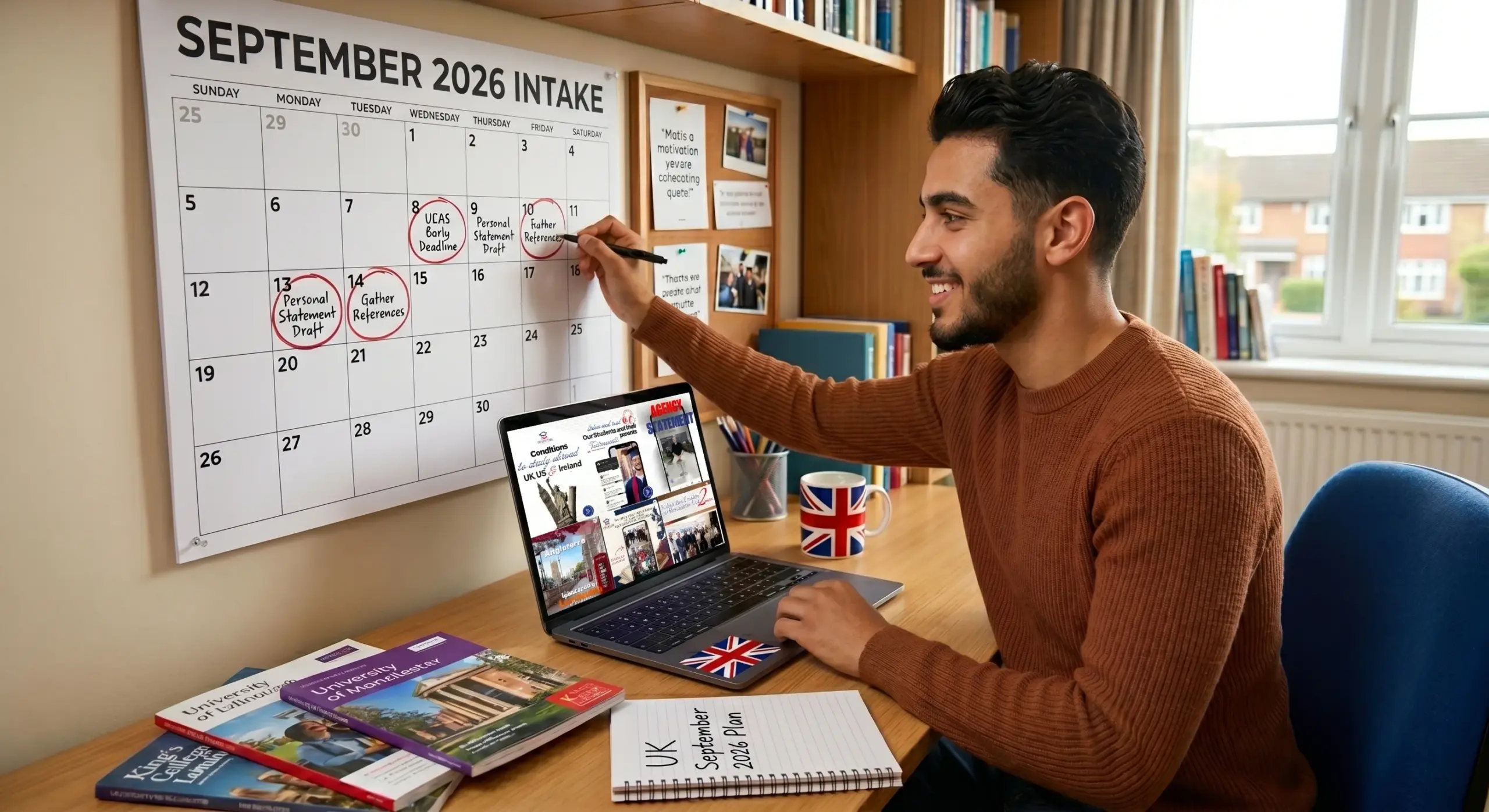
This is the primary intake, with the widest range of programmes available. Applications typically open 12 months in advance. For September 2026, you should start preparing now to secure the best options and scholarship opportunities.
A growing number of universities now offer January starts, especially for Business, Computing, and Engineering programmes. This is ideal if you missed the September deadline or need extra preparation time.
Some universities offer late spring intakes, particularly for Foundation and Pre-Master’s programmes. Deadlines approach quickly, so early action is essential.
For a detailed breakdown, read our guide on understanding intakes for undergraduate and Master’s degrees.
While requirements vary by university and programme level, here are the general criteria:
You will need to prove your English level through a recognised test. Most universities accept:
Not sure which test to take? Read our comparison: IELTS vs TOEFL for studying in the UK.
Prepare the following well in advance:
Download our comprehensive UK Documents Checklist to make sure you don’t miss anything.
Understanding the financial picture is essential for planning your move.
The UK government requires proof of £1,334/month (approximately 16,000 MAD) for living expenses in London, or £1,023/month (approximately 12,200 MAD) outside London. Typical monthly expenses include:
Many UK universities offer partial scholarships (10–35% of tuition) for international students. Education Club Agency has strong partnerships with universities and can help you access scholarship opportunities based on your profile and academic merit. Some key scholarship programmes include:
Once you receive your Confirmation of Acceptance for Studies (CAS) from a UK university, you can apply for your Student visa. The process involves:
For a step-by-step walkthrough, read our full UK Student Visa Guide for Moroccans.
Your Student visa allows you to work part-time during your studies:
Common student jobs include retail, hospitality, campus roles, and tutoring. The UK national minimum wage for workers aged 21+ is £11.44/hour (2025 rate), which can significantly help cover living expenses.
Moving to the UK is about more than academics. Here’s what daily life looks like for Moroccan students:
The global capital offers unmatched cultural diversity, career opportunities, and a large Moroccan community. Universities include UCL, King’s College London, Imperial College, and the University of East London.
Known for its vibrant student culture, lower cost of living than London, and strong universities including the University of Manchester and Manchester Metropolitan University.
Scotland’s capital combines stunning architecture with world-class education at the University of Edinburgh and Heriot-Watt University. Four-year undergraduate programmes offer a broader education.
The UK’s second-largest city has a thriving international community and universities like the University of Birmingham and Aston University. It’s also one of the most affordable major cities.
Home to Coventry University — one of the most popular choices among Moroccan students — with competitive tuition fees and strong industry connections.
Education Club is one of the largest representatives of British universities in Morocco. Our team provides end-to-end support at every stage of your journey:
All our consultation services are free. Book your free consultation today and start your UK journey.
Tuition fees range from £10,000 to £30,000 per year depending on the programme and university. Living costs average £1,023–£1,334 per month. A one-year Master’s degree, including living expenses, typically costs between £22,000 and £45,000 in total.
Some universities accept alternative tests like TOEFL, Duolingo English Test, or their own internal English assessments. However, IELTS remains the most widely accepted test for UK university admissions and visa applications.
Standard processing takes 3–4 weeks from your biometric appointment. Priority processing (5–7 working days) is available for an additional fee. We recommend applying at least 6 weeks before your course start date.
Yes. The Graduate Route visa allows you to stay and work for two years after completing your degree (three years for PhD graduates). There are no restrictions on the type of work you can do during this period.
UCAS (Universities and Colleges Admissions Service) is required for most undergraduate applications. Master’s and PhD applications are usually made directly to the university. Education Club Agency handles the entire process for you regardless of the application route.
Full scholarships are rare and highly competitive (e.g., Chevening). However, many universities offer partial scholarships covering 10–35% of tuition. Education Club Agency can help you identify and apply for scholarships that match your profile.
The best time to start planning is now. Whether you’re targeting the September 2026 intake or exploring January 2027 options, early preparation gives you the strongest chance of success. Here’s what to do:
Ready to start? Book your free consultation with Education Club Agency today and take the first step toward your UK degree.